Words have bones. Basic Manual of Endolinguistics. Alejandro Toledo Martínez, 2026.
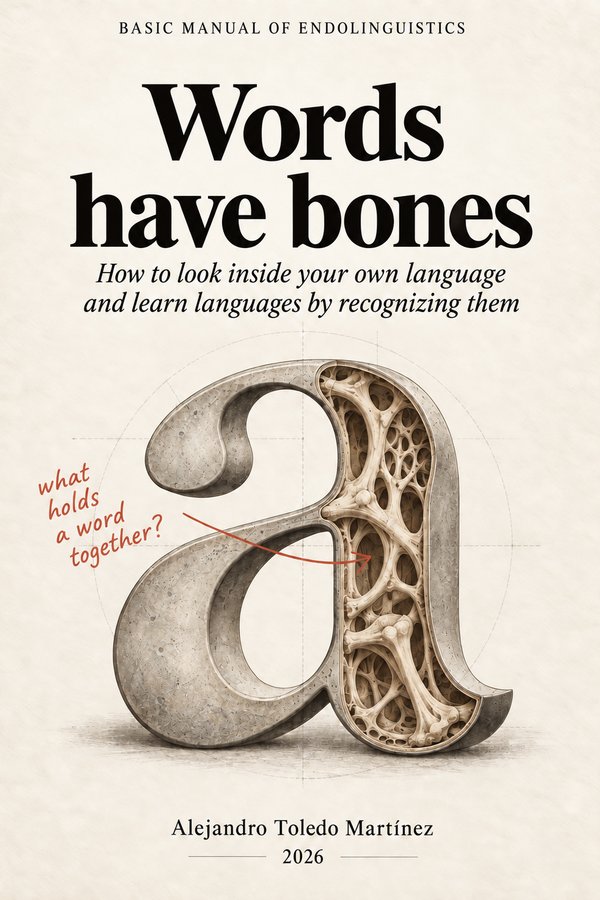
Your words are much older than you are. Strip away the flesh —the vowels— and keep the bone —the consonants— and you discover that father and Spanish padre are the same word with another accent, that the silent h of Spanish hijo used to be an f, and that much and mucho are near-twins without being relatives, a mystery endolinguistics takes seriously. This manual teaches you to look this way, and to use that way of looking to learn Spanish, French, German, Italian or Portuguese.
Start
Part I · Looking Inside
Part II · Using It to Learn Languages
- 5Relatives on the Road
- 6The Rules of the Road
- 7Pocket Maps
- 8The Method, Step by Step
- 9When There Are No Relatives